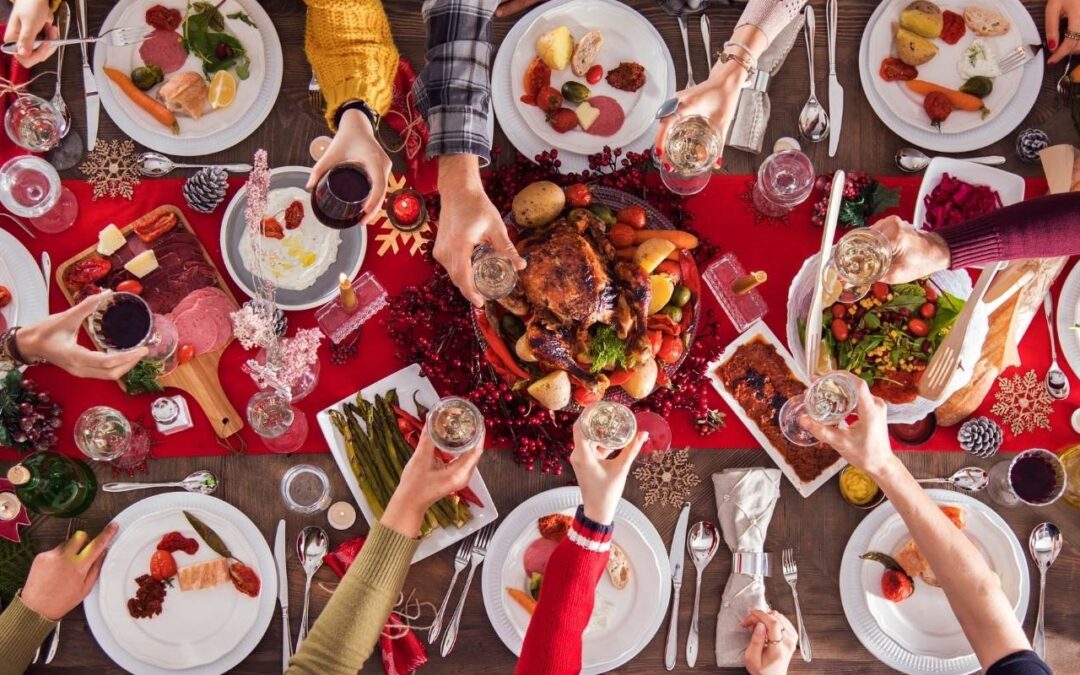
The holidays have a way of turning the volume up on everything.
Joy gets louder. Grief gets louder. old family dynamics resurface, and for many people, food—already complicated—becomes the centerpiece of stress, shame, control, or coping.
In a recent episode of The Bonded Podcast, we sat down with Christie Caggiani, a registered dietitian specializing in eating disorders and a certified intuitive eating counselor, coach, and consultant with more than 35 years of experience. Together, we explored what it really means to move through the holidays from an intuitive eating perspective.
Why Holidays Can Press Your Panic Button
No matter what you celebrate (or don’t), food is almost always central to holiday rituals and for many people, food has never been “just food”, it has been an emotional regulator.
The holidays intensify this because they bring us back into the family patterns we grew up with. Family tables often mirror early attachment dynamics: who was seen, who was shamed, who was praised, who learned to disappear. Add in family expectations, social gatherings, financial stress, grief, and unresolved trauma, and it can quickly feel like a pressure cooker.
Understanding this allows us to replace shame with meaning.
Food Is Not the Enemy (and Never Was)
A core principle of intuitive eating is unhooking from the idea that there is a “right” or “wrong” way to eat Food is necessary and meant to be pleasurable, it is neutral—not moral.
Holiday foods aren’t “bad” or “dangerous.” They’re often simply more flavorful, more satisfying, and tied to memory and connection. When we allow ourselves to eat consistently and without judgment, we’re more likely to:
- Enjoy food instead of fighting it
- Recognize hunger and fullness cues
- Avoid the pendulum swing between restriction and overeating
One of the most quietly radical ideas discussed in this episode is the importance of consistent nourishment, especially during emotionally charged seasons.
Inconsistent eating affects both metabolism and emotional regulation. When food is unpredictable, the nervous system stays vigilant. When nourishment is reliable, the body can soften.
Emotional Eating Is a Message
During the holidays, emotions are often front and center. Reaching for food to soothe sadness, loneliness, or stress doesn’t mean something is wrong with you.
Emotional eating is communication.
It may be saying:
- I am overwhelmed
- I am grieving
- I am lonely
- I am exhausted from holding it together
Sometimes food helps regulate emotion — and sometimes it reveals the limit of what food can do. Both are informative. Neither requires punishment.
When we allow ourselves to be present with eating rather than dissociated from it, we gain access to choice. And choice is where healing lives.
Consistent eating
is one of the most effective forms of self-care.
Not “saving up.”
Not skipping meals.
Not earning food.
Just eating—regularly, reliably, and without shame.
A Gentle but Firm Message About Kids and Food
Children do not learn about food in isolation. They learn from what adults around them say and do.
Diet culture in childhood is not neutral. It interferes with trust — both bodily and relational.
Kids are born knowing how to eat. When a child’s hunger is questioned, ignored, or moralized, the child learns to distrust their own internal signals. This fracture often persists into adulthood, long after the original context is gone.
If there’s one holiday vow worth making, it’s this:
- Don’t comment on what children are eating
- Don’t comment on their bodies
- Model neutrality, consistency, and permission
Coping Ahead = Self Care
If you know the holidays are hard for you, you’re allowed to plan for that.
Some gentle coping-ahead ideas:
- Give yourself permission to eat the foods you enjoy.
- Eat consistently before events (don’t arrive starving)
- Carry snacks when schedules are unpredictable
- Identify safe topics to redirect conversations
Self-compassion becomes real when it is enacted, not just felt.
Redefine What the Holidays Are “For”
One reflection is worth sitting with:
Who says what the holidays are supposed to look like?
The holidays are often treated as a moral test:
-
- Are you joyful enough?
- Grateful enough?
- Controlled enough?
- Indulgent enough?
But healing asks a different question:
What would make this season more honest?
Your relationship with food does not need to be resolved before you are allowed peace.

About Christie Caggiani RDN/LDN CEDS
As a Nutrition Therapist, Christie Caggiani speaks regularly to groups of children and adults, and counsels individuals in such areas as disordered eating, eating disorders, preventive nutrition, women’s health, and wellness. She is a Certified Intuitive Eating Counselor, providing one on one coaching to those who are determined to free themselves from diet culture. Additionally, she offers online workshops and courses to move the message of Intuitive Eating to groups of people in a safe, supportive setting.